
On my last post, Megan asked the following:
Would love to read more about your pasture management plan/turnout schedule and the reasoning behind it. I've been casually looking at farms and it's going to have to be small acreage so inquiring minds want to know 😋
You know you've done a good job when you're not seeing any erosion!
When I was planning to buy my property, I recognized that one of the biggest hurdles I would have to overcome and adapt to was to successfully use and management limited pasture. The lay of my land only leaves 2 acres available for turnout needs. This necessitates a dry lot and rotational grazing. Of course, this isn't ideal for three horses! But it's my reality and I was (and am!) determined to make it work in the best way.
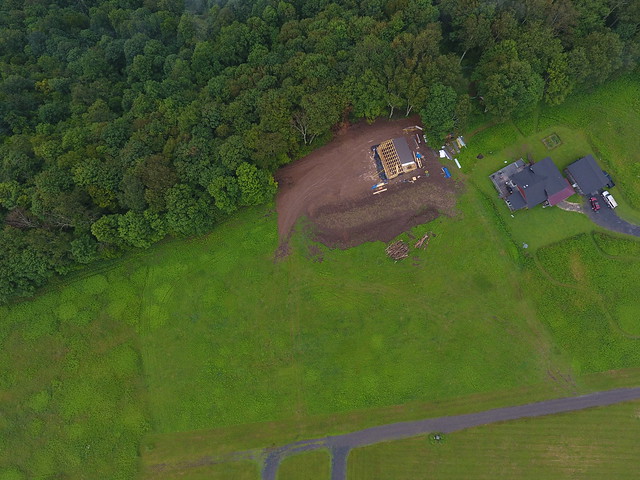 |
| Aerial view from last summer during construction. |
Step 1: Establish & Improve the Pastures
The first step to began last year when I hired a local farmer to come up and brush hog my future pastures. The area had been unmowed and unmanaged for a series of years. However, based on the surrounding lawns in my neighborhood that are maintained simply by routine mowing every year, I knew that this first step was bound to make a big difference for my future pastures. It's pretty outstanding what simple routine mowing can do to encourage grasses to grow instead of other forbs and woody stems (i.e., milkweed, goldenrod, Rubus species, hawthorn, etc.). It also helps immensely that this entire neighborhood was once a working cattle farm; my topsoil - as proven during construction last year - is pretty primo, even if it is currently lacking in some regards.
 |
| Brush hogging the golden rod. |
 |
| Look at all that gorgeous top soil! |
While mowing made a huge difference for my land, it was only the first step! Next, I took soil samples and send them to West Virginia University for free analysis. Yes, free. If you're interested in doing this for your own property, research the opportunities within your state. Many states offer the service free of charge for residents through Federal and State agencies and/or colleges and universities. If your state doesn't offer any of these services, you can always work with someone like Southern States who will both test your soils and then help you interpret the results and build a custom fertilizer mix for your needs.
Soil testing is important to do to determine what treatments are going to be best for growth of pastures/crops. Not all soils are the same! Environmental factors and land use practices dramatically influence the type and quality of soils. If you want to improve or change the composition of vegetation on your land, you've got to start with the soil. Plants need nutrients to grow well. And different plants require different nutrients. (Are all those various grade school science class lessons coming back to anyone else right now?) Anyone who lives in a rural area with farming should be familiar with this concept; many farmers rotate crops to help/improve their soils so that they better support other plants later on. (Nitrogen fixation is a big one.)


My soil results (above) told me that my soils were a bit acidic (pH of 4.6). The recommended treatment was to lime the pastures. I went a step further with my results, too, and emailed them to my local Southern States to get their opinion on what I should do. Through conversations with David at SS, I learned that liming was going to be my main focus for the next couple years. pH values don't change quickly. David said he'd like to see my pH value up closer to 6.
I did the first round of liming this spring, and I will likely lime again next spring, too. I plan to continue working closely with local experts and do my best to implement their recommendations. It will be a process, and it may change and evolve over time, but that's to be expected. I'm new to this and pretty fluid about everything (within financial reason). I anticipate that once the pH is at a more ideal level, I will look more into a custom fertilizer mix to improve the mineral composition of the soil. I will also likely perform disking/seeding to establish better forage over time.
Step 2: Prevent/Minimize Erosion/Sedimentation AKA No Mud!
I know I harp on this a lot since this project began, but I hate mud in pastures. It isn't great for the land, and it isn't great for the horses that live on that land. I dealt with some ridiculous mud at every barn I spent time around growing up. I witnessed situations that I now know were largely preventable with a bit of foresight and planning.
I knew going into my purchase that I was incredibly fortunate to be buying land that drained exceptionally well. When Dave had a perc test done years ago, the tester noted that it was one of the best in the region. Still, with neglectful practices that lead to gross mismanagement, anything can become a mud pit in a hurry in the east (as evidenced at other farms in the region I've spent time at). Too much hoof traffic can compact soils and damage vegetation above and below ground in a manner that negatively effects growth. This reduces the ability of vegetation to draw in water, which helps prevent erosion/sedimentation.
 |
| Barn with dry lot. As viewed from here, the French drain resembles a capital E: the toe of the slope is the vertical portion of the E and then the three horizontal figures extend on the far side of the dry lot, through the dry lot right before the overhang, and on the far side of the barn. |
The first big step to minimizing sedimentation/erosion/damage to my soils was opting to have a dry lot for the horses. This "armored" area would provide a place for the horses to spend the majority of their time without harming soils. Planning for this from the get-go to dramatically reduced the likelihood of issues. I also installed a pretty intense French drain in and around the dry lot to both protect it and further minimize the likelihood of sedimentation/erosion (especially of areas downslope of my property).
The next step to minimize sedimentation/erosion/damage to my soils was planning to have multiple [small] pastures to rotate the horses though.
Step 3: Pasture Rotation
Designing the property to have two pastures to cycle the horses' time on was the next step in my grand plan to manage my land in the best way possible. This would allow the land to have a rest period to grow and recover from the stresses of grazing/traffic and help guarantee that the land remains healthy and functioning as it should into the future so that it can continue to support my horses.
 |
| Majestic Grif posing during evening turnout a few weeks ago. |
Currently, the horses are turned out for 3 to 4 hours per day on days that the ground is not a soppy, wet mess. This is still a very fluid thing based on my learning and the weather/environment. I also have been turning them out for one month per pasture. However, with less precipitation (leading to less vegetation growth) this is likely to evolve as the land dictates.
Thus far, the pastures are looking really great. We had heavy rain event of ~2 inches in 45 minutes last week and the only place I noticed erosion from runoff was along the edge of the dry lot where the water running off the pasture pushed the stone dust around a bit and partially covered a T post that has been lying there since last year. (Yeah, yeah, I know I need to move it, but look how my procrastination has paid off - its helped me make this cool observation!)
Step 4: Future Plans?
Looking forward, I plan to continue soil testing, liming, fertilizing, disking, and seeding as necessary. The composition of vegetative species growing in the pastures is far from where I'd like to see it one day, but this is a process that takes time. And ultimately, as I have already stated, this process will be one that is on a very fluid schedule based on what the land is telling me it needs. Additionally, as I learn more from my equine nutrition course, my approach will likely change to help guarantee my horses the most balanced diet possible from their pasture.
 |
| Thunderheads rising above the pastures earlier this month. The near pasture had just completed it's month rotation with the horses on it. They're in the far pasture for July. |
Overall, I am very pleased. There is definite room for further improvement, but for the first year, I am super happy with the progress I've made and the land's response to that progress.

