

I have received so many questions, comments, and unsolicited advice on the breed since Kenai entered my life in 2010. I've learned a lot in my time with him, though I did do a TON of research on the breed prior to Kenai entering my life as I have been in love with the breed since I was a child (as my family can attest).
The following are some comments and FAQs about the breed I routinely answer and some clarifications about common myths/misconceptions. These are based on my research and my experiences with my dog(s). It should go without saying, but I am not an all-knowing expert - I learn new things all the time (e.g., the breed can be prone to alopecia) - and your mileage may vary.
: : : : :
If it's summer: Boy, your dog must be hot in this weather with all that hair!
If it's winter: Oh, this is perfect for your dog, huh?
If I had a nickel for every time I've heard these comments I'd be rich!
Yes, they are a northern breed. Yes, they thrive in cold weather. Yes, they can overheat easier than some other breeds if it is hot and humid AF. But mostly? Mostly they're FINE. They're fine because I'm cognizant of their needs no matter what the weather.
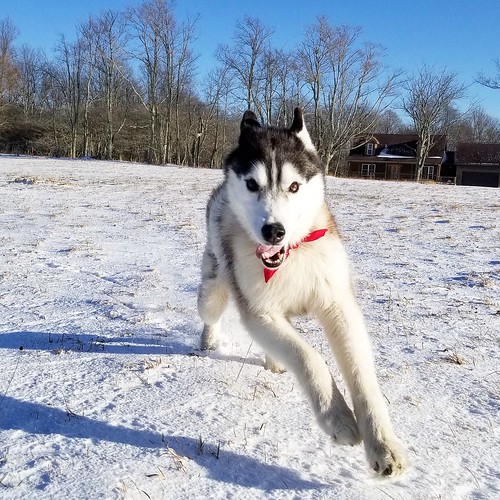 |
| He loves the snow, it's true. |
Siberian huskies have a double coat with a very plush undercoat and, due to human desire and selective breeding, the coats can be the typical medium length you most commonly see, or they can be wooly (long). While wooly coats may be pleasing to the eye, they're not doing the breed any favors as they protect them much less from the snow and result in a lot of snow/ice balls forming against the coat, which is uncomfortable for the animal and can result in them being very wet down to their skin which isn't desirable in cold weather.
Double coated dogs have two layers of coat: an undercoat that protects from heat, cold, and a top coat that helps to repel dirt and moisture. The denser the undercoat, the fluffier it appears.
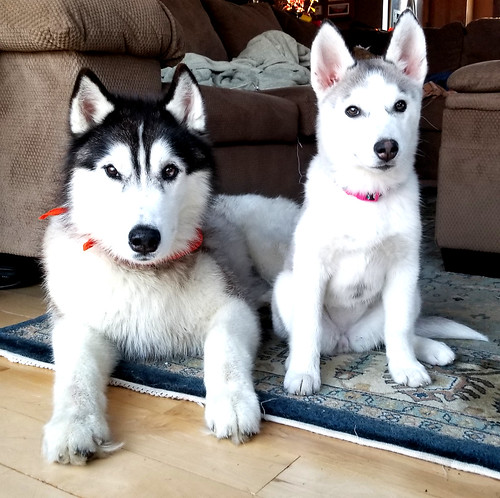 |
| Floof! |
MANY breeds have double coats! Huskies, labs, retrievers, Aussie shepherds, GSDs, newfies, sheepdogs, schnauzers, terriers, the list goes on! People tend to overlook that these other breeds also have double coats and may also have trouble over-heating in the summer. Personally? I feel more for newfoundlands in the summer than my huskies! A jet-black coat with an equally dark undercoat is gonna heat up a lot faster than my predominantly white undercoat with some darker guard hair dogs.
Do my huskies excel in winter weather better than other double coated dogs because of their denser undercoats? You betcha. But just because they have that denser undercoat and excel in winter doesn't mean that they are suffering in summer.
 |
| SPROING! |
This leads me to another very valuable point. Shaving your double coated dog (husky or not) to "help them cool down" in the warmer months is one of the biggest mistakes you can make as an owner. By doing this, you are removing his protection from the heat and allowing his skin to be damaged by the sun. Additionally, you cannot guarantee that the coat will grow back properly after it has been shaved. It may come back, yes, but the quality of the coat will likely be lesser than it once was, oftentimes with more undercoat than top coat. Every time I hear someone talk about shaving their double coated dog, it breaks my heart.
Don't huskies only have blue eyes?
Or, my personal favorite: If it doesn't have blue eyes then it isn't a purebred husky.
Sorry to burst your bubble, but huskies can have blue eyes or brown eyes or a combination thereof!
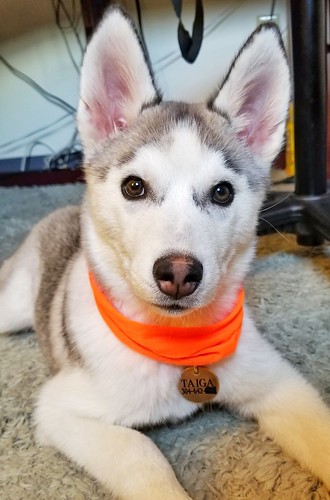 |
| Taiga's sweet brown eyes |
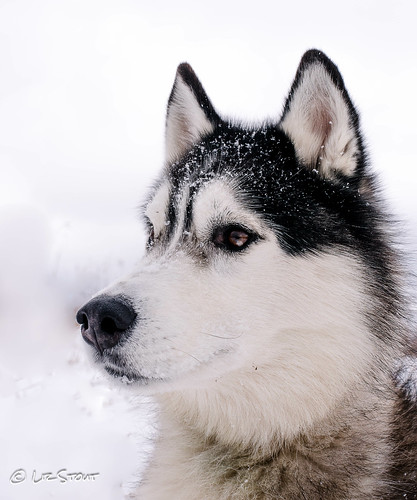 |
| Kenai's brown eyes, and light blue spot. |
In fact, some even have blue and brown in the same eye or have one blue eye and one brown eye. Austen's Sonka, a husky mix, had the most strikingly beautiful bi-colored eyes (blue and amber (! even more rare)) I've ever seen.
 |
| Blue eyed Lyra on the left and Sonka with his striking bi-colored eyes on the right PC: StitzPics; photo provided by Austen |
 |
| Sonka's beautiful amber eye featured here PC: Austen |
I've met people that have taken this assumption a step further and insisted that ANY blue-eyed dog in existence MUST have husky mixed in it if it has blue eyes. Um. No. Just no. Many other dogs can have blue eyes for a variety of reasons, though commonly dogs with a merle gene (carried commonly by Australian shepherds, Great Danes, dachshunds, collies, and shelties ) will also have blue eyes.
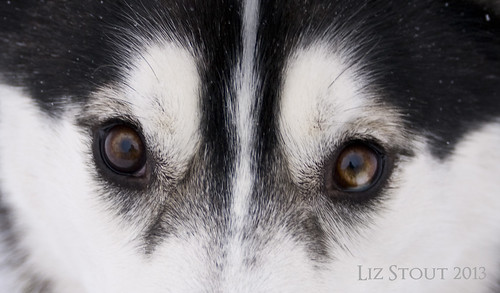 |
| Black rimming around Kenai's eyes and you can eve seen the blueish spot in his left eye |
A unique trait about huskies eyes though, are that they are rimmed by dark pigmented skin. This helps with glare and reflection and is present due to the breeds origins from snowy northern latitudes (bright white landscape).
Oh! He's so big!
Or, Oh, I bet she'll be huge!
Or even, He's going to keep getting bigger!
The breed standard for size in Siberian huskies is 45-60 lbs. and 21-23½ inches at the shoulder for males and 35-50 lbs. and 20-22 inches at the shoulder for females.
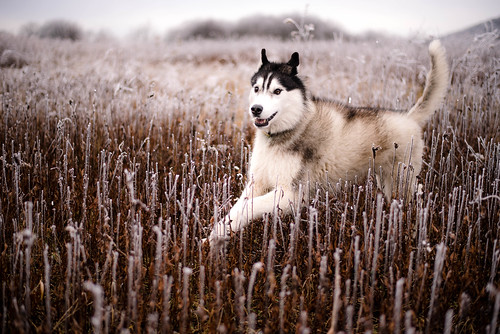 |
| Adventures in the hoar frost |
They really aren't THAT big of a dog. Their malamute cousins have much more height and weight on them though, which is likely the cause for confusion.
Their dense undercoat (fluffy appearance) can definitely be misleading though! But really, it's just fluff. Kenai may appear as if he's 70-90 lbs. to some people, but I swear to you, he's only 62 lbs (and 23 inches at the shoulder)! He is at the upper echelon of the breed standard, but he's not too far out of the ballpark at all. And no, random people who think he'll keep getting bigger, he's nearly 8 years old, I'm pretty sure he's full grown.
 |
| Small enough to go into a little backpack for the moment! |
Kenai's dad is the same size as Kenai - and built very similarly! His mom is only slightly smaller than the dad, probably around 50 lbs. Taiga's parents are both smaller than Kenai's parents (dad ~55 lbs and mom is 40lbs) and I expect her to mature somewhere between 35-45 lbs. She was the smallest one in the litter, also.
Don't huskies kill cats?
Kenai doesn't kill cats, no, in fact, he's raised two kittens that were each 4-weeks old when they entered our lives. Because he has been raised and trained to not see cats as prey, we have no problem. It doesn't mean he won't chase a cat - small fast-moving animals trigger that prey drive instinct like none other - but he won't harm them if he catches up to them!
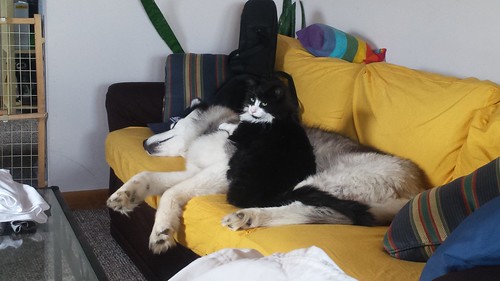 |
| Killed by the cat would be a more accurate description. These two loved one another so much. And for those who remember Atticus, he's still living large in Pittsburgh ruling his 2 humans, 2 cat siblings and his dog sibling. |
But other huskies can and will kill cats and any other prey-like animal. #murderdogs
Huskies have a high prey drive (and aren't the only breed that has one) and have a hard time resisting instinct to chase and subsequently murder small, fast-moving animals. You can train them to resist and listen to you above instinct, but it takes a lot of due diligence and they still may backslide. Example: Kenai didn't chase, bother, or harm chickens for years and years. I didn't even have to watch him when we were at the barn because I knew he wouldn't bother them. Then one day, he killed three! Now I'm highly vigilant of him any time we are around chickens to make sure he doesn't act on his instinct.
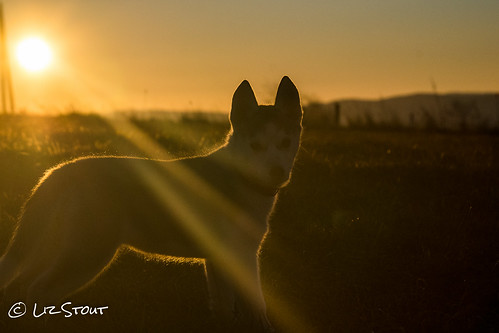 |
| Taiga at sunset |
Actually? Fun fact, huskies are quite cat-like! They're a tidy breed that appreciates cleanliness and is rarely dirty for long. Go on a muddy hike, throw Nanook in the back for the ride home, and more often than not, he'll emerge miraculously clean by the time you arrive home. Magic!
Other cat-like traits include the lightness with which they move, their pouncing and hunting behaviors, their curiosity, chirrup sounds of pleasure/communication, and lack of listening to you when you want them to most.
Don't they need a lot of exercise?
Yes. Resoundingly, yes. But to be fair, any active breed needs exercise! However, huskies were bred to RUN, so they obviously do better with exercise.
Huskies are much better citizens with a good exercise routine. Without it, they can be destructive or they will find a way to escape their confines (they are the ultimate Houdini!) to run and roam, often times not returning for days - if ever! This can be nerve-wracking for owners who subsequently have to worry about the dog being hit by a car or worse.
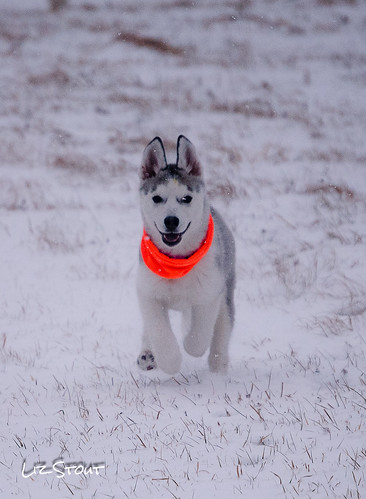 |
| Zoomies in the snow, recalling like a good girl |
Huskies are highly intelligent. If they have been adequately exercised, they'll settle and use their intelligence for good (human desired) actions, whereas if they have energy to burn, it's anyone's best bet! I'm sure we've all seen various memes of a couch, beanbag chair, wall, door, floor, fence, etc. that has been destroyed by a husky. I can guarantee you that each of those dogs in the memes could use more exercise!
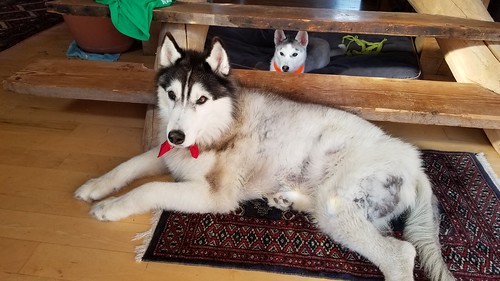 |
| Lurking while we were outside the window |
A lot of husky owners are runners (hi, Austen!) and keep their huskies sated in that manner, other folks have loftily fenced backyards for their dogs to burn off energy. Though one must be careful with fences and huskies! They can and will climb and jump and dig. Oft times, if you're going to have a fenced in backyard for your husky, it is recommended that the fence is not only tall (6+ feet, bonus points for a hot wire at the top) but also deep so that the dogs cannot dig and burrow underneath!
 |
| Horse play is an alternate form of exercise... Hard to believe Griffin was ever so dark; this photo is from 5 years ago! In fact, Griffin and my BO's border collie play almost every day. It's a really cool relationship. |
I am very fortunate to live in a very rural area with few neighbors and no traffic. As such, I am able to exercise my dogs primarily off-leash so they run and sniff the world to their heart's content without me having to suffer through the rigors of running (ugh, I really admire y'all, but no). However, this off-leash exercise does not come easily!
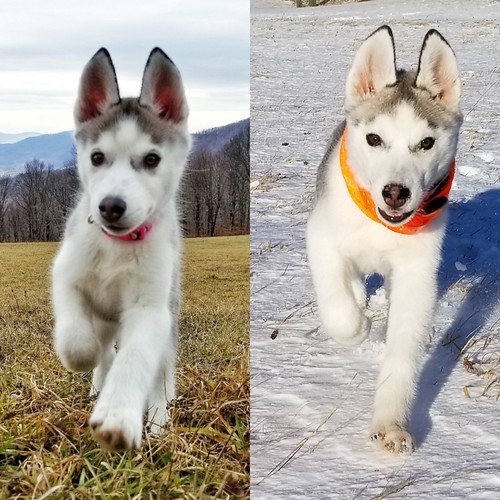 |
| Three weeks and 7-8 lbs gained! |
Huskies, a highly intelligent dog with a high prey drive that doesn't always listen to their owner, have notoriously shitty recall. If you've ever wanted a husky, more than any of the points I've made above, please know that recall is something you must practice again and again and again with your dog to have any kind of success. Recall is important both on and off leash for various safety reasons.
I researched the breed tirelessly from the time I was 8 years old until Kenai entered my life in 2010 and knew that recall would be something I focused on more than anything else with him. I buckled down hard for 2½ years hammering recall into him.
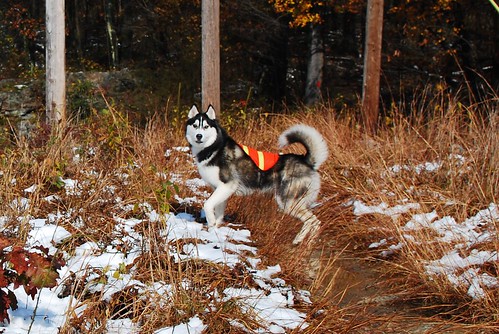 |
| Oh, be still my heart. Kenai in his full regalia prior to any knee surgeries or his alopecia hair loss |
A big facilitator in this effort was a remote shock collar; I am a big advocate for them if you want to have your husky successfully off-leash. I recognize that both off-leash dogs and remote shock collars can be highly controversial and I do not care to get into that with anyone. These methods work incredibly well for me and my dogs - your mileage may vary! Do know that I am sensitive to having off-leash dogs in more public areas and take appropriate measures as necessary when we are away from home.
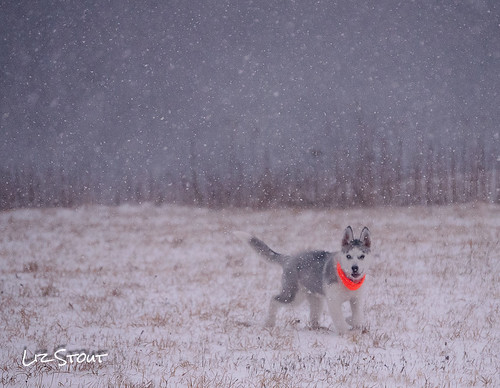 |
| Taiga fully appreciating the snowstorm last week |
Kenai has incredible recall as a result of my tireless training from a young age. He's remarkably good to a point where my neighbor who owns three wolf dogs of various content calls Kenai an "un-husky" because he listens to me well and doesn't run away from our house when he's left outside, off-leash, with no remote collar. Part of it is his temperament, but a lot of it is due to endless hours of training.
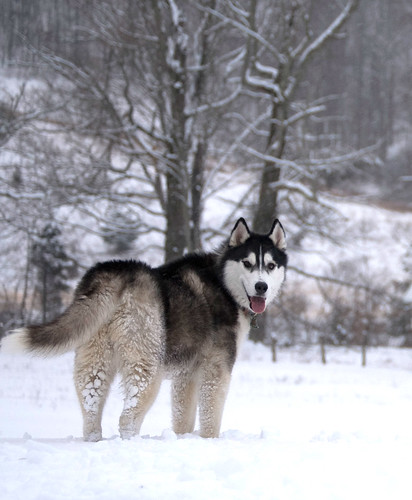 |
| In the horse field years ago lending me his eyes and ears when I asked for his attention |
Ultimately, I enjoy having well-behaved off-leash huskies. It allows them more opportunities to run to their heart's content and get enough exercise as I am not a runner! Additionally, it's great so they can go trail riding with the horses and I. I love when I can knock out a lot of birds with one stone and exercising a horse and the dogs in one fell swoop is a wonderful thing in my world.
: : : : :
I think the bottom line with any dog is to do as much research as you can about what the breed (or possible breed(s)) is like and what they need to have a happy, healthy lifestyle. If everyone took the time to research their desired dog well in advance of bringing the dog home and made every effort to help the dog find success for it's unique needs, there would be a lot more happy dogs and happy owners out there.

I've loved Siberian huskies since I was a child and spent years learning about the breed's pros and cons. Even though I could have brought a husky into my life earlier than I did, I chose not to because I knew my lifestyle wasn't going to be up to snuff for having a happy dog. I didn't want to have one until I could guarantee that it would have success and not get into trouble at every turn because of my own human errors due to scheduling/lifestyle.
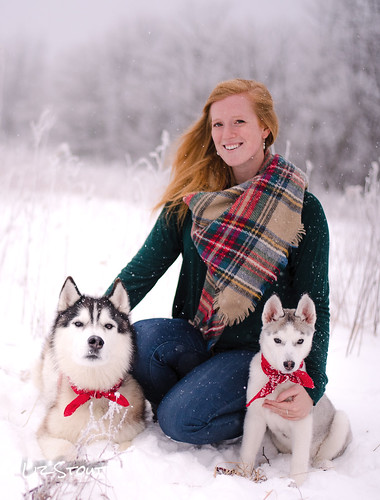
Dog's are a wonderful addition to my life, and I really couldn't imagine my world without a dog in it. I know many of you are the same. If you have one, I'd love to hear a little bit about your dog(s) in the comments if you'd care to share. Not a dog person? Tell me about your cat or other [insert-pet-here]!

